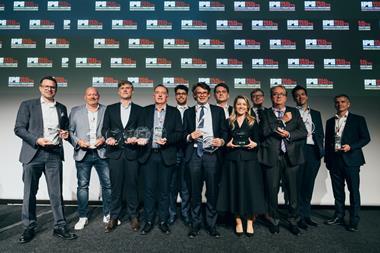





For global institutional investors, the rapid rise of AI infrastructure requires a top-down and bottom-up balance – managing end exposure across public and private markets while adhering to core infrastructure investment criteria, attendees at the IPE Real Assets Infrastructure & Natural Capital Global Conference & Awards 2026 in Munich heard this week.
Investors and fund managers revealed how they are navigating this shift, weighing single-digit levered yields, long-term take-or-pay contracts, public-private market exposures against rising technology obsolescence and platform exit risks.
Digital infrastructure has rapidly matured over the past decade. For large pension funds, the journey began with telecommunication towers before turning to hyperscaler data centres. Robin Lutz, senior director of infrastructure at La Caisse, said once data centre assets are built, they exhibit classic infrastructure characteristics.
“At least with the hyperscalers, you’re getting typically very long-term contracts – 15 years is sort of the norm in the industry. It’s take-or-pay contracts, so there’s no volume risk whatsoever. You have fixed escalators… And then importantly… the actual energy cost is borne by the underlying tenant by the customer.”
However, the advent of AI workloads has introduced distinct operational profiles compared to standard cloud computing. Fernando Gomez Fortun, senior director of strategy and business development at Azora, stated that data centre investing sits at “the convergence of real estate, energy and infrastructure”, adding that as demand for digital translates into physical infrastructure Azora is evolving its approach toward AI factory investment opportunities.
To mitigate technology obsolescence in compute capacity, Gomez Fortun said Azora structures shorter-duration contracts for graphics processing units (GPUs). “[We] underwrite those under traditional infrastructure contracts with maybe shorter duration, but six, seven-year, take-or-pay contracts,” he said. “And so, effectively, the technology risk is protected through the take-or-pay contractual period.”
Managing risk across asset classes remains a central challenge for pension schemes. Institutional investors must evaluate public equities, bonds and direct infrastructure holistically to avoid overconcentration in tech counterparties.
Roscoe Sun, investment director at Unversities Superannuation Scheme (USS), picked up on a point raised by the moderator Richard Lowe, editor-in-chief of IPE Real Assets, regarding investors’ exposure to AI and ‘big tech’ across asset classes. “We or any fund that like us can invest in the public shares of a hyperscaler, the bonds, and if they also buy a private markets investment, like a data centre platform with leases to those hyperscalers… we have to think about… the end exposure to those hyperscalers in the round.”

Sun added that UK pension fund USS maintains a strict bottom-up investment criteria: “Are the assets or the platforms in the right geographies? Do they have the right quality of powered land and permitted assets? Do they have the right management team culture, and do they have a track record of leasing and constructing data center assets on time and on budget? And we’ve passed on literally hundreds of opportunities over the years because they haven’t met our criteria.”
Sun also offered an analogy for their position in the market. “In data centres, we are selling the picks and shovels that are helping the gold miners mine for gold,” he said. “We believe though that in this industry those who develop the most attractive models and are well placed to do that will continue to need power, space and cooling, and that’s what we’re focused on at USS.”
Platform valuations and underwriting challenges
From an indirect and multi-manager perspective, the sector’s rapid growth presents specific underwriting hurdles, particularly surrounding platform valuations and exit assumptions.
Nicolò Buffa di Castelalto, partner and co-head of infrastructure at Amundi Alpha Associates, said data centres have graduated into an established asset class, but highlighted the risks around “this relatively young sector” that has yet to be fully tested. “Not many GPs have gone full cycle [and] demonstrated the ability not only to invest and grow assets but exit them successfully,” he said.
Buffa di Castelalto said platform pricing is a primary hurdle for achieving target returns. “The problem when we get offered investment opportunities, they are typically in the form of platforms,” he said. “And platform values today… tend to be relatively high. That means you will never be able to make double-digit return to the investor if you don’t continue growing.”
Raising concerns over long-term exit expectations, he said “almost all the platform investment opportunity we’ve seen have an exit scenario where the asset is worth tens of billions, if not more, and I don’t think that has ever happened before”. He added: “So all the options for monetising this exposure have necessarily to be… creative, and by that I mean not really tested that much.”
Beyond capital allocation and underwriting, power availability remains the defining physical bottleneck for AI infrastructure deployment. Addressing grid constraints, Lutz cited small modular reactors (SMRs) as a potential long-term development. ”I am a big believer in SMRs. I think it’s… actually happening a lot faster than people… might think… both at this scale sort of make sense to power potentially a data centre of that size with base load power, green power.”
Lutz added that data centre operators must proactively address their impact on local grids. “There is some growing sense that data centres are creating part of the issue that the grids are facing at the moment.” It is inevitable therefore that data centre investors need to think about how to mitigate this and even help the grid demend – to “maintain your social license to operate, which in the long term I would argue is key to the success of the sector”.
In agreement, Gomez Fortun added that off-grid solutions represent the broader direction of travel, supported by grid investments, storage and targeting secondary markets. “We’ve moved away from the FLAP-D markets. We focused on what we believe to be solid tier two areas like Southern Europe or like the Nordics,” he said.
To read the latest IPE Real Assets magazine click here.