


The 50 largest investors in natural capital have close to €80bn invested in the asset class, according to IPE Real Assets’ report at the beginning of the year. It is a sizeable chunk of capital, but it is only about 10% of the $912bn (€794bn) invested in infrastructure by the Top 50 infrastructure investors. This is a reminder that the fast-growing and evolving area of natural capital – which can include forestry, agriculture and nature-based investments – is still a niche activity from institutional asset allocation perspective.
But the growing need for more investment in biodiversity protection, sustainable forestry, food security and environmental resilience means there is good reason for a scaling up of the asset class.
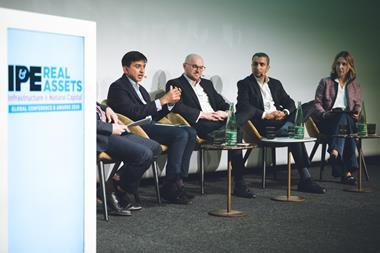
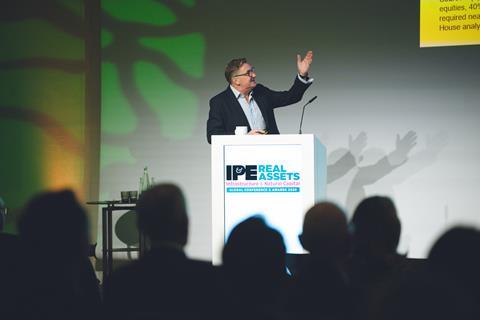
It could also be good for the risk-return profiles of institutional portfolios, according to Olly Hughes, managing director at Gresham House. Speaking at the IPE Real Assets Infrastructure & Natural Capital Conference in Munich, Hughes cited new research that found that introducing a 10% natural capital allocation could effectively lower risk without diluting overall returns, adding diversification and different return drivers.
“Natural capital will and can enhance a diversified portfolio,” said Hughes. “It will deliver better risk-adjusted returns in terms of Sharpe ratio, Sortino [ratio], diversification, tail loss. It will enhance your inflation correlation, and it will lower your equity beta.”
Many of the Top 50 natural capital investors have been invested in timber and/or agriculture dating back to a time before the term natural capital had been coined. But these traditional activities have begun to coalesce with newer, sustainable and impact-orientated investments, such as ‘nature-based solutions’, rewilding, reforestation and the generation of carbon and biodiversity credits.

For instance, the Pension Protection Fund (PPF) has been investing in timberland for more than 10 years. Alex Leonard, head of infrastructure and timberland, told the audience in Munich that the UK pension fund had enjoyed “positive experience overall” over that period, generating a “good risk-return” by building “a fairly traditional timberland portfolio”. Citing Hughes’ research, he said: “We’ve seen those portfolio diversification benefits that you talked about.”
The PPF has not made a wholesale move into newer areas like nature-based solutions, limiting this to additional activities around its existing assets. “There’s definitely some flexibility for sustainability and impact – and we do that,” Leonard said, But, he added, “I would not want it to become an asset class entirely dominated by sustainability”.

But some are going much further into the world of impact. Rob Gardner, founder of Rebalance Earth, has been working on creating what he terms resilience purchase agreements (RPAs) in the UK – modelled on power-purchase agreements – whereby land owners and businesses would pay for land restoration that improved flood and drought resilience of the local area, which is becoming a growing issue with climate change.
Gardner said: “Nature behaves like infrastructure, so it needs to be financed like infrastructure.” RPAs can turn “environmental risk into cashflows, making projects investible. “From a UK perspective, this improves our energy resilience – we don’t want our substations flooding. It improves our food resilience – the farmers who embrace this end up with better income but they also end up with lower costs [as] there are more crops per hectare, and their farm is more resilient to climate change.”
Balancing core timber with impact and optionality
One takeaway from the conference was that, arguably, the traditional income-producing returns of producing timber should remain the core of natural capital and be complemented by additional sources of return and impact, such as carbon and biodiversity credits, or including renewables on land.
“I don’t see it as a return versus impact or return versus sustainability,” said Tapani Pahkasalo, co-managing partner at Helsinki-based CapMan Natural Capital. “Being more sustainable has improved our returns as compared to the base case.” Traditional timberland investment is the “easy part”, Pahkasalo said, while generating “additional revenues” and sources of returns is where “90% of the focus should be” today.
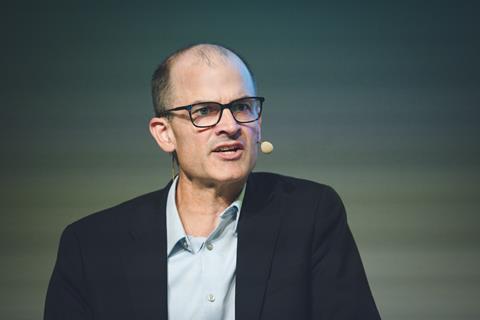
Even in the US, where concepts of sustainability and impact have taken on negative connotations and become “associated with inferior returns” the financial rationale is holding up, said Stavros Koutsantonis, chief operating officer at Boston-based Conservation Resources. “That puts a particular pressure on us to show that [sustainability] not only can be competitive in terms of return but really has to be superior. Our investment approach is focused on developing that so-called alpha, and the primary source of that comes from monetising the environmental values.”
Jim Hourdequin, CEO and managing director at The Lyme Timber Company, says “optionality” in US timberland – “to do something else with the land, develop it, conserve it, lease it for solar, sell carbon offsets” – had not been historically been fully utilised by investors, but this was now changing. “For some investors, the options were never realised during their hold period, and they were left with low income yields, and in some cases, disappointing returns,” he said. “In other cases, capital appreciation saved the day, driven by new investors applying even lower discount rates. But for much of the 2000s and 2010s my observation is that timberland was largely bought and sold as timberland – one investor picking up where the other left off.”
He added: “Over the last several years, even as timber markets have remained weak in the US, we’ve seen that several embedded options in timber end have started to pay: carbon offsets and carbon capture, solar and wind ground uses, conservation easements and fee sales, mitigation banking, new wood markets, mass timber packaging and biofuels.”
To read the latest IPE Real Assets magazine click here.