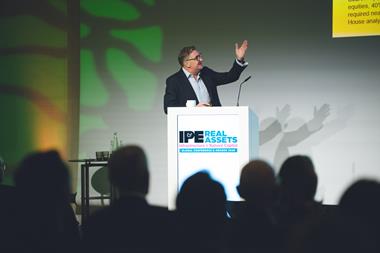




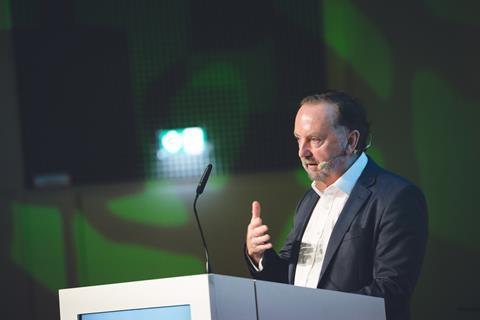
”Energy transition in Europe is no longer being driven solely by climate ambition – it is increasingly being driven by security, sovereignty and competitiveness.” With these words, Graham Matthews, chairman of infrastructure at Patrizia, set the tone at this year’s IPE Real Assets Infrastructure & Natural Capital Global Conference & Awards 2026 in Munich, laying bare the dual pressures of geopolitical realignment and physical system constraints facing global real asset investors.
Speaking on the shift across European markets, Matthews explained that the transition is now expected to deliver three core national objectives: “Security through less dependence on external energy supplies; sovereignty through greater control over critical infrastructure and supply chains, and competitiveness through access to reliable and affordable energy.”
These priorities are reinforcing climate targets rather than replacing them. While EU gas imports from Russia have fallen from 45% to 12%, Europe has created new concentration risks, with around 63% of its LNG imports now coming from the US. Meanwhile, total energy transition investment across Europe has more than doubled from around €250bn in 2020 to almost €600bn by 2025.
However, Matthews warned that power generation is no longer the sole bottleneck, as physical grid connections create severe operational delays. “Seven years – that’s the average wait time for a new grid connection across Europe’s major data centre hubs today. In the most constrained markets, it can exceed 13 years just to get a grid connection,” he said, adding that “in 2024, some €7.2bn worth of energy was curtailed or wasted simply because the system couldn’t fully absorb or transport it”.
Meeting Europe’s broader goals will require approximately €12trn of infrastructure investment over the next 15 years, requiring annual infrastructure capital to nearly triple to approximately €800bn a year.
Following the keynote presentation on Powering Europe’s Energy Transition and Security, Matthews moderated a panel discussion on the same theme with industry figures: Sebastian Carneiro, CEO and co-founder of Solas Capital; Nick Langley, head of real assets at Franklin Templeton; Igor Lukin, managing director at Allianz Global Investors; and Robert Szatkowski, senior investment director, Infrastructure at APG Asset Management.
Addressing the alignment between national security and net-zero targets, Szatkowski said: “In my view, there is no contradiction between the energy transition and energy security, or security in itself. So it’s all very complementary, and we see it, in my view, by each day actually we are proving that investments in the energy transition are needed to secure the automotive targets, which should be in Europe to become as far as possible independent from the fossil fuels.”
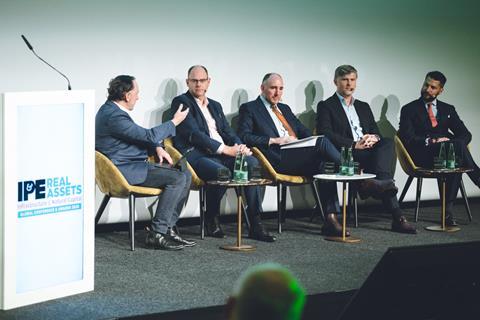
Lukin talked about how market drivers have expanded since the early 2020s, saying: “In energy, you have this trilemma, right? You have sustainability, you have security supply and availability… back then, you only had one element – decarbonisation – and the other two elements were kind of behind the shadows. But now… the other elements are coming in.”
On portfolio deployment, Langley warned against relying on ‘silver bullets’. “Think about the hard-to-avoid areas of the economy,” he said. “Think about it from a systems-led investing perspective. Where do I put my dollars to work? Where I’m going to take out choke points or pinch points in a system that has essential flows in it?”
Carneiro stressed the importance of the demand and energy efficiency side of the equation. “If you look at the transition and how climate and energy security works, the demand side is equally important than the generation side,” he noted. “Every kilowatt we don’t use in the first place, we don’t need to invest in generation.”
Global policy context
Setting the scene for these market dynamics, Miranda Schreurs, Professor of Environment and Climate Policy at the Technical University of Munich, had opened the conference by outlining the global geopolitical landscape shaping clean tech transitions.
Schreurs gave a blunt assessment of international climate targets, saying: “We are rapidly coming to the era where we can say we have already missed the first of the Paris Climate Agreement targets of trying to keep global average temperatures to below 1.5 degrees Celsius above pre-industrial levels.”
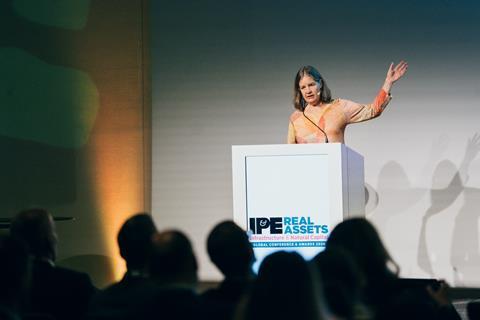
In her opening address, she detailed how global geopolitical realignments are shaping industrial strategy across major economies. She contrasted a US political environment where “the idea that US competitiveness is linked to investments in the fossil fuel sector” with China’s “ecological civilisation” push, having “put in more renewable energy capacity than the rest of the world combined, year after year after year”.
Turning to Europe’s position, Schreurs talked about the risks of regulatory drag and political retreat, saying: “My fear is that right now, because of this nationalist politics that strengthens itself in Europe, that we might put the brakes on some of the transitions moving towards that Green Deal. And, if we do, I think Europe will become increasingly unimportant in the economy of the future.”
The subsequent panel discussion built directly on this foundation, expanding on her themes as an extension of that global backdrop to examine how institutional capital must navigate these international pressures on the ground.
As Matthews concluded in his opening address, Europe’s ultimate challenge is no longer about setting targets, but achieving rapid execution on the ground. “The question is how quickly Europe can build, connect and scale the infrastructure required to drive it,” he said.
To read the latest IPE Real Assets magazine click here.