



Speaking in separate interviews at the IPE Real Estate Global Conference & Awards 2026 in Rome, senior executives from Dutch pension fund investor APG and the World Bank Pension Fund revealed how AI, data centres, a reassessment of risk and ensuring fund manager and investor alignment were reshaping capital deployment.
Christina Scarlato, principal portfolio manager for the World Bank Pension Fund, said investors globally must “get comfortable around the uncomfortable” in the current market. For her, AI acts as an essential leverage tool. “I would say it’s safe to say that we almost use it every day now, finding better ways to use it, and more efficient ways to use it,” Scarlato said.
Asked whether data centres are infrastructure or real estate, Robert-Jan Foortse, managing director of European real estate at APG, said “data centres are real estate for us”, adding that, while it is a “demarcation battle in many of our firms,” APG’s real estate and infrastructure teams actively pool resources. “I always think about my mother, who is 90 years old, and a participant in the ABP pension fund, and she honestly doesn’t really care whether it’s with real estate or whether it’s with the infrastructure.”
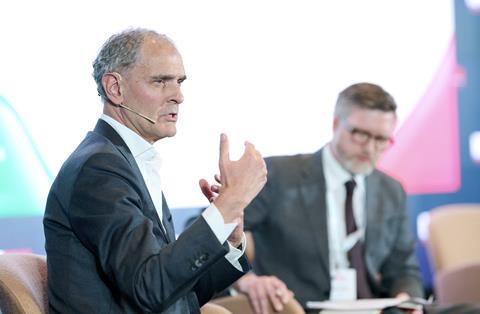
Scarlato was equally agnostic when it came to asset labels: “Quite frankly, the reality is whatever the manager puts on the cover, and we can do both, and we’re happy to get that exposure.” However, she draws a clear structural line based on operations. “To me, if you’ve just built a box and then give it to Amazon to manage, to me that’s real estate. If you’re managing the insides of the box, then that’s more infra,” she explained.
Both investors are also adjusting how they take risk. APG, for instance, is tilting heavily toward Europe via a €5bn domestic mandate focused strictly on Dutch affordable, student and senior housing, effectively redirecting capital that might otherwise have gone to the US or Asia-Pacific.
“We do not take planning risk,” said Foortse. “We are only getting into these projects at the stage where essentially we can start building the day after.” He added that the investor was exploring whether it had been properly rewarded for taking platform and development risks in recent years.
For the World Bank Pension Fund, the search for returns has led it away from large-scale managers and toward emerging managers, with Scarlato pointing to widespread corporate consolidation in the asset management industry.
“I am really struggling these days with a lot of our managers being bought out. One of our managers sold themselves, and didn’t tell us, we found out when the press release came out,” Scarlato said.
She added that she was also not in favour of continuation vehicles, viewing them as mechanisms to protect fee-generating assets under management (AUM) rather than discover true market prices. “If you’re building your AUM to be sold, we have a real problem because I don’t feel like we’re a partner anymore, and so I think it’s my job to go out and find replacements for those managers.”

Scarlato said the World Bank Pension Fund relies heavily on its limited partner (LP) network to back first and second-time funds where alignment remains pure. “Emerging managers outperform stabilised managers,” she said. “There’s just more skin in the game… You’re fund one, and you don’t do well, you’re not going to raise a fund two.”
To read the latest IPE Real Assets magazine click here.