




Data centres have generated 23.8% returns over the past 15 years, but investors should be wary of concentration risk as real estate, infrastructure and private equity funds all converge on the sector with overlapping strategies.
According to MSCI, data centres have outperformed the wider markets for private equity (18.1%), private infrastructure (12.5%) and public equities (10.1%) on an annulised basis since 2011, but the acceleration and broadening of the sector now poses risks of over-exposure to asset allocators.
Investment in data centres has “evolved into a multi-asset-class segment” totalling US$122bn (€103bn), MSCI argues, with real assets strategies typically providing direct exposure to physical infrastructure, while private equity strategies “capture a broader set of companies across the data centre value chain”.
MSCI analysed 584 data centre companies and assets held by closed-ended funds and found that real estate and infrastructure funds represented 60% of the total exposure, while private equity buyout, expansion and venture capital represented a further 36%.
According to the report by Keith Crouch, Wendy Hu and Jorge Velazquez of MSCI Research & Development: “This cross-asset footprint carries important portfolio implications. Allocations may appear diversified by mandate yet remain anchored to a common economic driver: computational demand.”
Further evidence of this can be seen in ownership trends – as of Q3 2025, 13.6% of data centre companies were held by funds spanning multiple asset classes. “Asset-class diversification therefore does not eliminate thematic concentration,” MSCI concluded.
“Asset owners, consultants and general partners should be aware that asset-class diversification may obscure thematic concentration risk: data centre exposure spans asset categories, but returns remain tied to computational demand.”
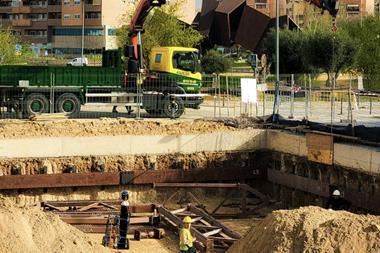
The pace of acceleration in data centre investment can be seen in the rate of global construction starts, which rose in estimated completed value from US$60bn in 2020 to US$340bn in 2025, according to MSCI Real Capital Analytics data.
This growth was initially led by infrastructure investment, which had accelerated before the commercialisation of artificial intelligence (AI) large-language models (LLMs), but “investment momentum spread” following the release of OpenAI’s ChatGPT in the fourth quarter of 2022.
“Infrastructure valuations continued to rise, while real-estate exposure expanded alongside it, reflecting parallel growth to support increasing AI-driven compute density, power demand and energy intensity,” MSCI said.
The pace of valuation growth was particularly pronounced in 2023 and 2024, with aggregate valuations increasing by approximately US$33bn driven by US$26bn in capital contributions and US$29bn in appreciation. During those two years, the sector generated US$22bn in distributions to investors.
MSCI found AI-led growth of stock markets had led to data centres’ outperformance becoming less pronounced in more recent months. From 2023 to Q3 2025, MSCI’s data centre index recorded an annualised return of 19.2%, outperforming private equity (10.4%) and private infrastructure (10.5%), but trailing global public equities (21.2%), with the latter “buoyed by the same AI enthusiasm since the launch of ChatGPT”.
To read the latest IPE Real Assets magazine click here.