



Institutional activity is increasingly shaped by the convergence between real estate and infrastructure, reflecting a major shift in how large allocators build portfolios.
At the INREV Annual Conference 2026 panel, Allocating in an uncertain world: defining real estate’s role, industry leaders said that this convergence trend is being driven by the digital and energy transitions, pushing investors to rethink traditional management approaches.
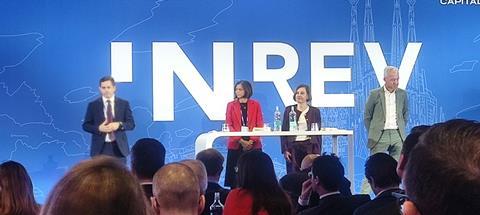
Moderated by Andrew McDougall, global head of multi-asset at Mercer, the discussion acknowledged that while the “mood music” around property has improved, real estate is now operating in a far more complex alternatives landscape.
McDougall said the asset class, once the primary anchor diversifier, now competes directly for capital with infrastructure and private credit, necessitating a “Total Portfolio Approach” to maintain agility.
The panel discussed how this structural evolution is being driven by the need for greater control and transparency. Lars Dijkstra, PGGM’s CIO, pointed to a move toward a “three-dimensional” strategy where sustainability KPIs are weighted equally with risk and return.
Kamila Horackova, CIO of NN Group also pointed to the rise of real estate debt as a distinct asset class within private credit. According to Horackova, the insurer has real estate debt, “but for us, it is in the private debt portfolio”. It is a separate asset class and it is really competing with other private credit sub-classes, she added.
According to Jenny Buck, CIO of London CIV, capital is actively rotating into specialised sectors like data centres, further blurring the lines between traditional property and essential infrastructure.
The CIOs further discussed how the definition of risk has shifted from simple diversification to a more dynamic pursuit of resilient cash flows. Dijkstra detailed how PGGM’s transition out of retail and into logistics has already proven its ability to deliver returns over the last decade; at the same time, Horackova clarified that NN now views real estate as a “very dynamic” asset class. Horackova said risk management today is less about broad exposure and more about the specific “diversification possibilities” within sectors like logistics and residential to build a truly resilient portfolio. This resilience is being tested as real estate, once the “first kid on the block” for alternatives according to Dijkstra, faces stiff competition for capital.
Both Buck and Horackova identified infrastructure equity and private credit as primary competitors, with Buck pointing out that these asset classes now challenge real estate’s traditional role as the defensive income provider. This has led to a debate over whether the industry is seeing a structural convergence of asset classes or a “thematic” convergence.
While Buck suggested the lines are blurring, Horackova maintained it is “both,” as investors maneuver between related disciplines to find the best relative value.
Europe’s regional stability and the ‘rule of law’ premium
The discussion surfaced a counter-intuitive perspective on Europe’s regulatory landscape, with Dijkstra arguing that the continent’s complexity is a structural strength for long-term capital. According to Dijkstra, the perceived “Achilles heel” of Europe, the difficulty of reaching consensus among 27 different nations, actually provides a high level of stability.
He said because the “rules of the game” cannot be changed overnight by a single populist leader, the region offers a unique “rule of law” premium. According to Dijkstra, “In Europe, it’s very difficult to change the rules of the game… and that is a huge advantage for an institutional investor.”
This stability makes Europe an attractive destination for global capital seeking predictability in a “rapidly changing and less stable investment environment.”
To read the latest IPE Real Assets magazine click here.