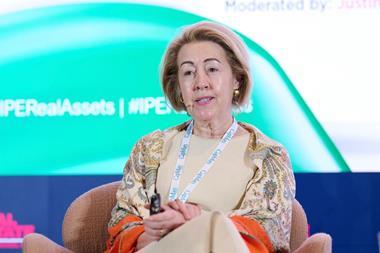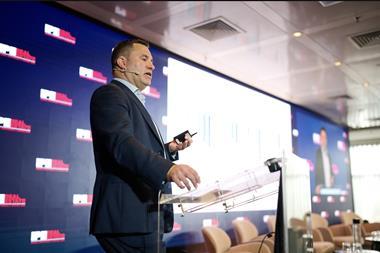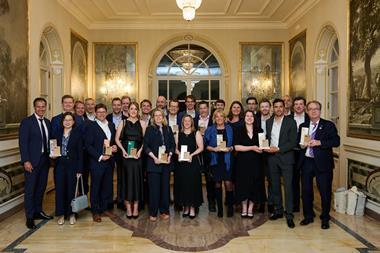

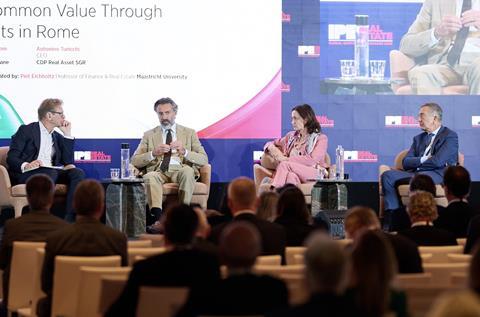
Rome is entering a crucial “phase of transformation” centred on upgrading public infrastructure and launching a series of major public-private partnerships, according to Maurizio Veloccia, Urban Planning Alderman for the Municipality of Rome.
Speaking at the IPE Real Assets Global Conference on Thursday, Veloccia said the city plans to invest €8bn in public infrastructure – including metro, tram and rail expansion, as well as social housing – in a bid to boost its attractiveness while reducing inequality.
“I think public transportation is the main challenge in Rome – the main gap between Rome and other European cities,” Veloccia said. “But also housing, housing, housing. That is a major issue in Rome: affordable housing, social housing, public housing.”
Veloccia also stressed the importance of balancing urban regeneration with sustainability in the ‘Eternal City’. “Rome is unique, so we need to find a very careful balance between these two elements,” he said.
To accelerate the transformation, the municipality is pushing for constitutional reform that would elevate Rome to an independent tier of government with direct legislative authority. The reform would grant the city special autonomous status and legislative powers in areas such as urban planning, public transport and tourism, allowing Rome to bypass regional agreements and establish its own urban development framework.
“This is very important work that will allow us to change the rules and simplify processes such as land-use changes and the regeneration of disused buildings,” Veloccia said.
He added that the city has “more than 96sqkm of transformable land and more than 10m sqm of disused non-residential buildings”.
Among the largest regeneration projects is Tor Vergata, a 48-hectare site in eastern Rome that includes an unfinished sports facility designed by renowned architect Santiago Calatrava. The project is expected to attract around €1bn in public-private investment focused on innovation, education, research and housing.
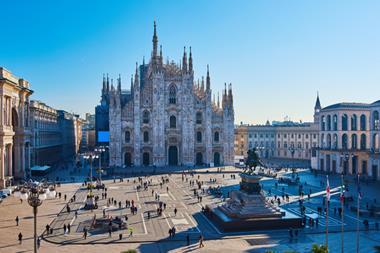
Manfredi Catella, founder and chief executive of Italian asset manager Coima – the group behind Milan’s Porta Nuova regeneration – said Rome is approaching a pivotal moment similar to Milan’s transformation between 2000 and 2010.
“At that time, large projects emerged and Milan became what most of you have experienced directly or indirectly,” Catella said. “I think Rome is at the same trigger point, so from a timing perspective it is very interesting to invest here.”
Being late to regeneration may ultimately prove advantageous, he added. “Rome is late in regeneration, but I think today this is actually an advantage because the public administration can update its agenda using current knowledge and best practices.”
Catella also praised what he described as the municipality’s “visionary” governance approach. “The current municipal administration demonstrates the same kind of visionary governance shown by Milan under Mayor Albertini in the late 1990s and early 2000s, viewing urban transformation as a driver of economic, environmental and social development,” he said.
Coima was recently selected as development partner for the central Guido Reni redevelopment project by Cassa Depositi e Prestiti, the state-controlled investment and fund management group focused on urban regeneration, social housing and the redevelopment of unused public assets.
Located in Rome’s Flaminio district, the €550m redevelopment of the historic Guido Reni barracks is set to include roughly €400m of residential facilities alongside a €120m science museum known as Science Forest. The five-hectare site will be redeveloped through a newly created fund managed by Coima and backed by CDP Real Asset’s FIV fund, Abu Dhabi-based developer Eagle Hills and the Coima ESG City Impact Fund.
Antonino Turicchi, chief executive of CDP Real Asset SGR, described CDP’s role as enabling large-scale public-private regeneration projects by assuming the early-stage risks that private investors are often reluctant to take on.
“When you start a project like this, you have what I call the ‘first mile’,” he said. “The first mile is the most difficult part of a regeneration process because it involves environmental, architectural and urban-planning issues that can take years to resolve – 10 years in the case of Guido Reni – and carries significant risks that the market typically avoids.”
“But completing this phase is crucial before a project can move forward. We support this type of risk because we believe it is essential to attracting long-term investment capital.”
CDP currently manages €1.5bn of urban regeneration investments across Italy, including €1bn concentrated in Rome across seven projects.
Once the de-risking phase is completed, CDP launches transparent and competitive processes to select development partners while retaining investment stakes in the projects rather than simply selling development rights
“This approach serves as a bridge between the public and private sectors,” Turicchi said. “It also helps ensure projects are successfully completed. Our role is not simply to present and sell a project, but to invest alongside our partners because our objective is to help transform parts of the city.”
To read the latest IPE Real Assets magazine click here.