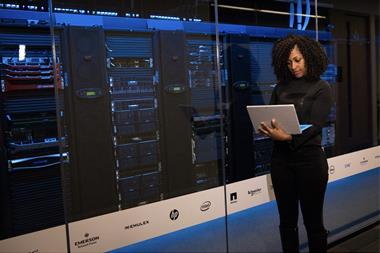



Global data centre investment is expected to reach $31.6trn (€27.3trn) through 2050 to build the compute capacity required for AI, with the US capturing almost half of the global total, according to a report by PwC.
The US is expected to account for $15.1trn of spending, supported by its central role in the advanced-chip ecosystem and its high concentration of AI model developers and hyperscalers. Asia-Pacific is forecast to capture $8.2trn, led by China and India, while Europe is expected to attract $5.6trn.
On an annual basis, global data centre capital expenditure is set to more than double, rising from roughly $800bn in 2026 to $1.8tn by 2050.
PwC, which commissioned Oxford Economics to model data centre capital expenditure across 46 countries and territories for its Global Data Centre Outlook, said that unlike traditional infrastructure cycles that reduction after an initial construction phase, AI infrastructure spending is expected to accelerate over time.
“This is driven by recurring hardware upgrades, as expensive graphics processing units and servers age out and require replacement every four to six years,” the report stated.
As a result, information and communications technology equipment will account for the vast majority of capital expenditure – rising from 70% of total spend today to 93% by 2050 – effectively making data centres a recurring hardware subscription wrapped in a building shell.
According to the report, the core forces determining where investment lands globally will be led by power, specifically the availability of affordable, reliable and low-carbon electricity at scale.
Capital deployment will also depend on latency and connectivity, robust data protection regimes, proximity to semiconductor supply chains, and efficient local planning and grid approvals. Clara Cutajar, global infrastructure leader, PwC Australia, said: The AI buildout is not a rising tide that will naturally lift all boats.
“Capturing this investment requires active positioning. Investors should recognise data centres as hybrid assets with a complicated risk profile.”
To read the latest IPE Real Assets magazine click here.