





Prologis’s £14bn (€16.4bn) “best and final” offer for Segro, its fourth attempt in just over a month, has achieved the breakthrough the US industrial giant was fighting for. Following weeks of tense rejections, Segro’s board announced that it has unanimously concluded the financial terms of the fourth proposal are “at a level that it would be minded to recommend to SEGRO shareholders”.
What began in mid-June with an initial £12.6bn all-share offer rapidly transformed from a high-stakes corporate standoff into one of the largest foreign takeovers of a UK-listed real estate investment trust (REIT). On paper, the deal would grant shareholders of London-listed Segro a 10.5% stake in a combined company boasting a $141bn (€124bn) market capitalisation, forming the world’s largest logistics real estate platform.
But stripping away the headline numbers reveals a far bigger story: the NYSE-listed logistics giant is not simply ‘buying warehouses’. It is acquiring one of Europe’s largest, most irreplicable portfolios of power-enabled, grid-connected infrastructure at an opportunistic entry price – and this explains the relentless series of bid offers.
Prologis made no secret of its primary motivation, arguing in an investor presentation that its “access to public and private capital… will enable Prologis to unlock and accelerate the embedded value of Segro’s development and data centre pipeline, which Prologis believes Segro is unable to fully realise on a standalone basis, given its balance sheet capacity and persistent trading discount”.
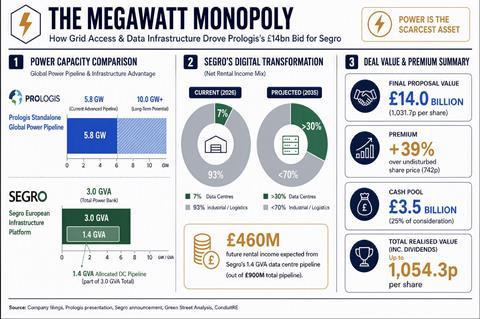
Prior to agreeing to terms, Segro’s board fiercely defended its standalone valuation, laying out its digital infrastructure credentials to prove its portfolio was fundamentally undervalued by public markets. Built over two decades of developing powered-shell assets, Segro controls a total “3.0GVA power bank across FLAP-D and emerging Availability Zones”.

Of its total £900m potential future development rental income, £460m is expected to come directly from its 1.4GVA allocated data centre pipeline.
Segro projects that data centres will drive “more than 30% of net rental income by 2035, up from 7% today”. Furthermore, 65% of Segro’s portfolio is concentrated in supply-constrained urban markets, including “Europe’s largest data centre cluster at Slough”.
Segro initially maintained that Prologis was taking advantage of a “temporary market dislocation” driven by Middle East geopolitical tensions and yield pressures across UK and European real estate.
Chairman Andy Harrison previously slammed Prologis for trying “to acquire Segro on the cheap when our share price has been dislocated… at a price that reflects none of the quality, scarcity and growth embedded in the business”.
Prologis countered by pitching the strength of a combined $140bn-plus mega-REIT. In its attempt to win over Segro’s investors, Prologis pointed to its own “power pipeline of 5.8GW across approximately 30 projects… with a longer-term estimate of 10GW+”.
Key to Prologis’s case was its criticism of Segro’s reliance on project-level joint ventures, such as its agreement with Pure Data Centres. Prologis argued that “Segro shareholders will give away significant value and upside to joint venture partners while, unlike Prologis, not earning any fees or promotes that would amplify returns” at high leverage of 70% loan-to-cost, due to balance sheet constraints.
Pointing to its integration track record with major acquisitions like Duke Realty, Liberty Property Trust and DCT Industrial, Prologis insisted its balance sheet could capture developer margins that Segro simply could not extract alone.
What the analysts say
Industry commentary reinforces why Prologis fought so hard for this specific target. According to ConduitRE, in today’s digital economy, “competitive advantage increasingly begins not with algorithms, but with access to power”, adding that “access to power has replaced location as commercial real estate’s scarcest asset”. With the securing of grid capacity in Europe now taking far longer than constructing physical buildings, ConduitRE argues that Prologis’s bid is a direct wager on asset optionality – “owning power-enabled industrial land that can seamlessly adapt between automated logistics, battery manufacturing, or hyperscale AI data centres”.
According to updated analysis from Green Street, Prologis is not overpaying despite the headline premium of approximately 39%. Green Street notes that Segro’s undisturbed share price sat at a severe discount to fair value, driven largely by years of governance underperformance and an inability to fully capture the market value of its underlying data center and grid assets.
While acknowledging the deal may cause modest near-term FFO dilution of 0.5% to 1% in 2027, Green Street stresses that short-term earnings are the wrong yardstick. The transaction is expected to be modestly accretive to Prologis’s NAV on day one, with the true economic engine stemming from long-term NAV accretion as Prologis unlocks Segro’s non-income-producing 3.0 GVA energy and data centre pipeline.
Institutional alignment and the final sweetener
Even before Prologis tabled its fourth offer, major institutional shareholders with stakes in both entities pushed for a resolution. Norges Bank Investment Management, holding 8.3% of Segro and 1.3% of Prologis, publicly said: “We understand the strategic rationale for a combination of Prologis and Segro. We believe the proposal merits consideration, and we encourage the boards of both Segro and Prologis to enter into constructive discussions.”
They were joined by APG Asset Management which holds 5.1% and 2.3% stakes in Segro and Prologis, respectively, and UK institutional manager CCLA Investment Management, all calling on Segro’s board to engage.
The breakthrough came when Prologis delivered its best and final £14bn proposal of 0.0920 new Prologis shares for each Segro share, valuing Segro at 1,031.7p per share, representing a 39% premium to undisturbed prices. The proposal includes a partial cash pool of up to £3.5bn, representing 25% of total consideration. Including permitted dividends, such as the expected 2026 final dividend of up to 22.56p, total realised value reaches up to 1,054.3p per share. Additionally, Prologis contractually committed to establishing a secondary listing on the London Stock Exchange.
Reflecting on the proposal, Dan Letter, CEO of Prologis, said: “There is no doubt a combination of both companies would deliver meaningful value. We have listened to feedback from shareholders and this morning, we have improved our proposal to make a compelling offer to the Segro board. We run Prologis with discipline and this is our best and final offer.”
With the Segro board officially on board, subject to final terms and confirmatory due diligence, the UK Takeover Panel has granted an extension until 5pm UK time on 12 August to allow time to finalise the transaction.
To read the latest IPE Real Assets magazine click here.