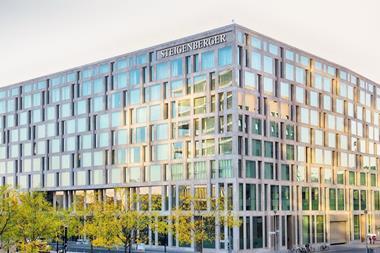


The strong appetite for global property investments has prompted Real IS to develop another fund focusing on Australia, its ninth fund to date. Due to be launched in January 2013, Bayernfonds Australien 9 will be a pure equity fund with approximately A$130 mln (EUR 105 mln) and an initial annual return of 6% from a green building located in downtown Adelaide, the state capital of South Australia.
The strong appetite for global property investments has prompted Real IS to develop another fund focusing on Australia, its ninth fund to date. Due to be launched in January 2013, Bayernfonds Australien 9 will be a pure equity fund with approximately A$130 mln (EUR 105 mln) and an initial annual return of 6% from a green building located in downtown Adelaide, the state capital of South Australia.
The building’s rent roll is mixed, with nearly 60% of the floor area used by public sector tenants.
The new Australian fund should appeal to both private and institutional investors who want to hedge their currency risk, said Jochen Schenk, member of the board of Real IS. ‘The economic conditions in Australia are quite different to those in Europe. This building is in a prime location in Adelaide with a multi-tenant profile.’
Aside from Australia and Germany, Real IS also has assets in the UK, France and the Netherlands. In due course, Schenk sees potential to expand Real IS’ reach to South America and Asia combining fund of fund concepts there and direct investments in Europe, North America and Australia. A new source of investor demand is coming from individual units within insurance companies which have more specific asset liability matching requirements, Schenk said.
‘There’s huge demand for global mandates integrating pan-European investments.’
The Munich-based closed-end fund manager belongs to the lucky few who have been swimming against the tide since the outbreak of the global financial crisis. While many fund managers are struggling to raise capital, Real IS has secured equity commitments approximating EUR 400 mln from institutional investors in its home country in the year to date.
The total sum breaks down into about EUR 110 mln earmarked for its southern German regional fund, sales for which were recently started, and approximately EUR 290 mln for the BGV series of pan-European funds.
‘What we are seeing at the moment is that institutional investors are committing themselves in a very wide cross-European spread or else in highly specialised regional products, such as our regional fund for southern Germany,’ Schenk said. Real IS is also currently working on two funds for two separate mandate clients.
In recent months, the German government has put forward plans to heavily regulate new open-ended real estate funds following the implementation of the AIFM Directive into German law in July 2013. The initial proposals - involving an abolition of new open-ended funds - have caused huge consternation in the German real estate fund industry and prompted speculation about a mass exit to Luxembourg by German open-ended fund managers.
As a closed-end fund manager with long experience of regulated products, Real IS is not directly affected by the plans. Schenk is also optimistic that his business will continue to flourish due to growing demand from institutional investors. The fund manager already has a regulated Luxembourg vehicle and under new European passport rules will be able to operate anywhere.
Nevertheless, Schenk is concerned about the proposed changes in Germany which could stifle the creation of new Spezialfonds or funds targeting institutional investors by open-ended fund managers. ‘Luxembourg will win if the Germans don’t get their house in order. Fund managers will look for escape routes and important parts of the industry will run to Luxembourg. That’s not good for the market.’