

Prospects for offices and residential property in Paris are positive as a new wave of foreign investors hits the French capital, was one of the key messages from PropertyEU’s European Outlook H2 2017 Investment Briefing, which was held recently in Paris.

‘Dry powder is plentiful,’ said Jarek Morawski, panellist and director of research and analysis at Grosvenor. ‘There is appetite and optimism, and investors are certainly willing to invest.’
Investment volumes into France, which have hovered around the €30 bn mark for the last two to three years, should begin to nudge up. ‘Demand is strong and I am very very optimistic about the French market,’ said Alain Chaussard, CEO of Affine.
‘Prices will be positive in the coming year,’ said Raphael Tréguier, CEO of Cegereal. ‘Even before the elections the market was strong and there was a good balance between supply and demand. Now everybody feels secure and all the components that are needed to improve demand for offices and residential are in place. The new wave of confidence in France should have a positive impact on rental growth.’
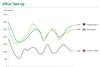
The latest figures seem to paint a positive picture. Office take-up in the Paris region has increased to 2.5 million m2 so far this year from 2.4 million m2 at end-2016, a figure just below Germany’s big four cities combined but above central London. In addition, vacancy rates have been going down, said Richard Malle, global head of research, BNP Paribas Real Estate.
In the first five months of 2017 transactions over 5,000 m2 in Paris have increased 11% to 376,000 m2. ‘We now expect a rebound for large office take-up in the city,’ he said. ‘Our forecast is a 20% increase.’ In 2017 total returns are expected to be at around 7.9% for Paris as a whole, relatively strong compared to the two previous years, but higher in the CBD (9.6%) and in La Défense (10.8%).
Brexit effect
Brexit is expected to have a positive impact, with at least some banks and companies relocating staff from London, as HSBC has already announced it will do. Another positive development for the city is the big infrastructure development known as Grand Paris. ‘Greater Paris should change the profile of our office stock dramatically, with high-speed trains connecting all the office hubs,’ said Tréguier. ‘With these new hubs and rental growth, we should break the €30 bn investment volume cap that we have been stuck at for quite a while.’
What is good for offices is good for residential, is Grosvenor’s credo, as a long-standing believer in the urbanisation trend. The French recovery story is attracting an increasing number of foreign investors: whereas they accounted for 10% of all prime residential transactions in Paris in 2007, that figure now stands at 60%.
Looking at the demographics, it is obvious that young people are coming to Paris in ever-greater numbers and are not finding what they are looking for. ‘We are filling a gap in Paris,’ said Morawski. ‘Many young people are moving to the city to find work, they are priced out of the city centre and they cannot find suitable accommodation. They do not want to commute, they want to cycle or walk to work and the residential sector has to change to meet that demand.’
Grosvenor has been focusing on the city’s North-Eastern quadrant, ‘a vibrant, under-developed area with a lot of potential’, he said, doing development and also buying offices to convert into residential. ‘We look at the complete picture, from resi to retail, to influence and improve the neighbourhood,’ he said. ‘We do not just play the cycle but seek to change the nature of the area for the long term.’ This is what being a long-term investor means, Morawski stressed: ‘Grosvenor has a 300-year history and we are now looking at the next 300 years.’