

Europe’s leading listed real estate companies are clearly in recovery mode, judging from the latest spate of half-year earnings reports released over the summer.

Across Europe, REITs and other listed property firms posted rising income and profits, with very few exceptions. The stellar performance cut across all segments, from retail, offices and logistics to emerging asset classes such as residential, healthcare and hotels.
The biggest REITs in terms of market capitalisation led the way with Europe’s largest listed property company Unibail-Rodamco reporting net rental income rose 3.5% in the first six months of 2017 compared to the year-earlier period, despite a further decline of 4.8% at its Dutch shopping centres. The Netherlands was the only country which did not contribute to the positive result, the Paris-listed company said.
Internationally the listed real estate sector is still benefitting from tailwinds as the cost of debt continues to fall, says Peter Papadakos, analyst at London-based Green Street Advisors. ‘From an earnings perspective, things are looking brighter and, significantly, cashflows are not falling while many continental REITs are seeing positive or even very strong portfolio revaluations.’
Changing growth dynamics
The same may not be true for UK REITS which are seeing values stabilising or falling slightly. But even though it has been anticipated, the potential for headwinds from interest rates is not strong, he adds. ‘Generally, prospects for rental growth are good on the Continent although they are somewhat challenging in the UK. But even in the UK we do not believe values will plummet, but plateau.’
Papadakos distinguishes between two operational cycles that are helping to buoy the sector at present. ‘The investment cycle has been roaring for the past three years, but now the rental cycle is taking off as well.’ There is still significant room for rental growth for offices on the Continent, he adds: ‘Rents there have not grown anywhere near what they have for London offices since 2012. The rental recovery hasn’t really kicked in yet there. On the Continent, rental growth could offset any potential impact from rising long-term interest rates.’ Higher rents are on the cards for offices and industrial assets in particular. In that context, retail assets form an exception, he says. ‘Nobody is expecting big increases for retail.’
One of the reasons that real estate is currently in a sweet spot is the fact that there is not enough class A office stock across the Continent, from Paris to Berlin and Stockholm and Milan. New developments will need a few years to complete and demand is already increasing. Any correction that does occur will not be supply driven, Papadakos claims. ‘Either there will be a demand-driven shock or there may be something on the credit side that could disrupt. I don’t think it will be the real estate fundamentals that will cause a correction, if there is one in the next 12 months.’
One cloud that Papadakos does see on the horizon is financing conditions for development on the Continent. While financing conditions are favourable on the whole, that does not hold for development at a time when development and completions are below the long-term average.
Cheap financing
That said, Europe’s listed companies are currently enjoying an exceptionally benevolent financing environment on the whole. At the presentation of its first-half earnings in July, Paris-based Unibail-Rodamco reported that its cost of debt had fallen to a low of 1.4% for an average loan maturity of just over seven years.
The achievement reflects Unibail-Rodamco’s strategy to diversify its sources of debt financing since the outbreak of the financial crisis when lending conditions in the traditional banking sector became extremely tight. The following figures illustrate how successful its diversification strategy has been: at end-June 2017 the Paris-listed company’s reliance on traditional bank loans had fallen to just 9% with capital market instruments including corporate bonds comprising a hefty 91%.
While this is an exception, many other listed European companies have successfully tapped the capital markets in recent years. Over the summer, a string of German residential specialists including Grand City Properties, its parent Aroundtown and Berlin-based Ado Properties issued commercial paper or bonds with coupons ranging between 1.3% and 1.8%. But not all companies are benefitting to the same extent from the historically low interest rate levels.
For example, London-listed retail landlord Intu is paying 4% for a seven-year maturity compared to 1.4% for Unibail-Rodamco. Diversification of funding sources has become a common theme in the real estate sector in recent years and even smaller companies like Brussels-based logistics provider WDP have significantly reduced the share of classical bank loans to finance their businesses. At WDP’s earnings presentation in early August, the company’s CEO Joost Uwents told PropertyEU that debt issuance now accounted for 40% of the total.
Indeed, in the past 10 years, debt issuance in the listed real estate sector has by far exceeded equity raises, research from EPRA shows. Since the outbreak of the financial crisis, 2009 was the only year in which Europe’s listed sector saw more equity being raised than debt. Since then, debt issuance has dominated.
In fact, EPRA research shows that the amount of debt capital being raised by the listed real estate companies that the industry body tracks is higher than ever before. In 2016, listed real estate companies raised €16 bn via corporate debt issuances, the highest amount ever raised. The sector is now on track to break another record in 2017, EPRA fi gures show. In the first six months of this year, European listed real estate companies have already raised €10 bn in debt issuance and it now seems very likely that the sector will exceed last year’s level.
UK majors drag down Europe
Given the historically low cost of debt, it is not surprising that Europe’s listed real estate sector is currently riding a M&A wave. In June Paris-listed Gecina announced that it had successfully placed three tranches of a €1.5 bn bond issue to part-fund its friendly takeover of peer Eurosic with an average coupon of 1.3%. The move has propelled the office landlord into the top 5 in Europe and France now accounts for three of the biggest real estate players.
Meanwhile in Spain the REIT sector appears to be thriving with new specialists like Kingbook Inversiones Socimi – the country’s first-ever petrol station REIT – becoming the 36th REIT to list on the Madrid stock exchange over the summer. In July, Spanish REIT Hispania took the next step in its strategy to become one of the top hospitality landlords in the country – and the only one in Europe – following the flotation of its €790 mln joint venture with hotelier Grupo Barceló.
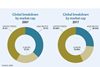
These positive developments mask a fundamental problem for those who have set their sights on a flourishing listed real estate sector in Europe. Despite the introduction of REIT regimes in France, the UK, Germany and a host of other countries in recent years, the total market capitalisation of the leading listed property companies in the UK and on the Continent has hardly budged at all over the past 10 years. At the end of Q2 2017, the value of the total listed real estate sector in Developed Europe was $448 bn (€380 bn). This compares to $431 bn at the start of 2007. By contrast, the market cap of the listed real estate sector in the US is almost 2½ times bigger at $1.16 tln. Even Asia-Pacific is more successful on this count with a market cap of $735.2 bn.
The development of Europe’s listed real estate sector is ‘very disappointing’, says Green Street’s Papadakos. ‘This tells us something about how badly Europe has performed versus the US.’ The market cap of the listed real estate sector in the UK in the early 1990s was massively bigger, he points out. ‘The UK majors were badly funded before the crisis. If you look at LandSec, its 10-year shareholder return is 0%. What drags down the listed market in Europe are the UK majors.’
European REITs have failed to deliver
Alex Moss, managing director of London-based Consilia Capital, believes the difference between the growth of the US and European listed real estate sectors post GFC is also partly explained by structural diff erences. He points to the fact that listed US companies tend to tap the equity market once or twice a year whereas their European peers have had far less equity issuance and have focused on debt issuance due to record low available coupon rates of between 1-2%. Moreover, the majority of European IPOs have been small in size. In addition listed companies in the US do not need to engage in equity issuance on a pre-emptive basis as they do in Europe, he notes.
‘That means they can access new shareholders far more quickly and if there is demand, an equity issue occurs overnight.’ The fact that listed European companies have engaged relatively infrequently in share issuance in the past decade is not the only factor that has constrained the growth of the sector, Moss says.
Another key difference between the US and Europe is the strong focus on NAV in the UK and Europe where the shares of listed real estate companies tend to be anchored to NAV. By contrast, US companies tend to be valued in terms of a multiple of their earnings. With many European companies trading at a significant discount to NAV, the market has in recent weeks seen a spate of share buybacks, Moss points out. ‘In terms of market cap, Europe is actually getting smaller.’
There is no reason for the European REIT industry to pat itself on the back, says Mark Abramson, an American REIT fund manager based in Munich and co-founder of Andama Investments. ‘It has been dwarfed in terms of the amount of capital that has flown into the sector over the last decade or so through other less liquid and lower quality vehicles – like OPCIs in France, SGR funds in Italy and open-ended funds in Germany. The European REIT sector may not be a complete failure, but it has achieved no more than 10% of its potential.’
Stable income
Abramson points out that the size of the real estate market in Europe is estimated at as much as € 17 tln. ‘REITs follow the same logic as the sexier-sounding, shared economy that gets the tech geeks excited, everybody should own in their investment portfolio a little bit of diversified real estate to some extent. Most can’t without REITs.’
Abramson claims that the vast majority of European REITs are not focused on the ‘boring, simple and predictable’ job that they should be doing, that is managing income to deliver stable dividends. ‘A lot of companies themselves, their executives, their boards of directors, their shareholders and the broader investment community have never properly internalised what a REIT is meant to do. REITs are meant to be safe, income-generating, tax-efficient, transparent, liquid securities that provide a safe anchor to diversified portfolios. Not every stock in one’s portfolio needs to be a Google.’
Companies don’t need to pursue growth to be relevant to the equity capital market, he adds. ‘In fact the opposite is true. There’s a large segment of the investing community that craves boring. REITs should fulfill a certain function of providing boring, consistent and frequent income, always. Through the whole cycle.’
At last year’s EPRA conference, there was much excitement about the fact that global index providers such as MSCI and Standard & Poor’s had elevated listed real estate as a stand-alone sector in the global benchmark for equity indices. Industry experts deemed the move as significant and predicted that Europe’s listed property could be in line for €75 bn in capital inflows over the coming years.
So far, however, there has not been any evidence of more capital flows into the sector following the index tweak, research from EPRA shows. One of the views held by some experts is that the listed real estate space remains the domain of specialist stock-pickers.
Cause for optimism
Nevertheless, there is some cause for optimism, Green Street’s Papadakos says. Germany’s share in the index has risen from 8.7% in 2012 to around 20% now and the rise of Germany’s residential sector with heavyweights such as Vonovia coming out of nowhere to burst in at the top 5 is also encouraging, he adds. At the same time, the number of failures has been fairly limited, with the exception of isolated examples such as IVG, Risanamento and Metrovacesa, he adds.
‘There may have been a few failures at the edges of the market, but there have been no major failures in Europe. There are far more failures in the direct rather than the indirect market, but you don’t hear about that!’
And in terms of returns, the sector as a whole has performed well since the peak of the market in 2007, with an average 7-8%. ‘That’s [quite] OK. The listed real estate sector offers income-like returns and a good inflation hedge.’