


Australia’s logistics sector has attracted a wave of new global entrants. Florence Chong reports

In Australia today, vacant warehouses are nowhere to be seen. Some large tenants are having to make massive ‘down payments’ to secure space. They undertake long leases and commit big capital outlays to facilities yet to be built – or they build their own sheds.

A mere 445,000 sqm of space is available nationally – down 82% from a peak of 2.4m sqm in late 2020. Landlords enjoy full occupancy.

According to Knight Frank, a record 2.5m sqm of new space is going to be developed this year, but 43% of that planned supply is already spoken for. Sydney will account for 808,000 sqm of the figure, of which three quarters is pre-committed and 10% owner-occupied. 

Australia’s tightest industrial market is Sydney. There, prime rents jumped 38% last year and rose again by 8.2% in the first quarter of 2023.

In Melbourne, according to CBRE, the vacancy level is about 1% and the pre-commitment rate is high for new developments due for completion over the next three to four years. Across the country, average rental growth in 2022 was 23%, the strongest is three decades. 

Brisbane’s overall rental growth increased by 9.6% in the first three months of this year, followed by Adelaide and Perth with 2.5% and 2%, respectively. Melbourne grew by 1.5%, according to Knight Frank.

Peter Guevara, JLL Asia-Pacific research director, says rental growth is expected to remain strong over th e medium term and that, given the lack of available space, tenants will continue to pay a premium.

“Occupiers are increasingly compromising on the lack of available space by taking short-term leases in existing, smaller-than-desired spaces before securing a pre-lease for a larger space,” he says.

Against this backdrop, it is hardly surprising that global capital continues to flock to Australia.

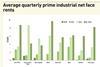
Among the most recent arrivals is Canada’s Cadillac Fairview, which has formed a joint venture with Gateway Capital Partners. The ambition is to build out a portfolio worth A$1bn (€618m). Cadillac Fairview has, however, arrived at a time when the rampant rental growth is showing signs of easing.

Average quarterly prime industrial net face rents

Stuart Dawes, Gateway’s chief executive, says: “I think the industrial and logistics sector has a long way to run here in Australia. There continues to be a shortage of warehousing facilities in urban locations which, when coupled with strong rental growth, provides the opportunity to create core prime-grade assets in these locations.”

Dawes says that with some groups facing pressure from rising interest rates, he is “definitely seeing opportunities to buy assets which might not have been available last year”. He continues: “There is a lot of property coming to market at the moment for various reasons and I think that, as much as the cost of debt, it is also about freeing up capital by owners to use within other parts of their business.” 

Dawes is in advanced negotiations on assets and expects to close transactions soon. 

Currently, more land is being zoned for industrial use in the far-western suburbs of Sydney. When this comes online it could have a dampening impact on rental growth. But Dawes is unconcerned. “You need to draw a distinction between the outer suburbs and inner-city infill markets,” he says. “I don’t think the infill market will be affected. This market caters to tenants who need to be close to their customers. There are limited options for these tenants.”

He sees a bifurcated market, with the outer suburbs catering to the “big boxes” and the inner-city market for last-mile fulfilment.

“The infill market is characterised by lack of supply,” he says. “We see opportunity to identify the assets, and with active management or expansion and redevelopment, we can add value to create prime-grade assets.”

Gateway also runs a build-to-core logistics platform with Invesco Real Estate. The investment marked a return by Invesco into the Australian logistics market.

Centennial, a Sydney-based boutique real estate investment firm, has secured the backing of Brookfield for its A$700m fund for last-mile logistics, Enhanced Value Partnership. 

A surprise entrant to the market is the global multifamily specialist Greystar. Chris Key, Greystar Australia’s chief executive, says: “Greystar’s industrial platform was established in the US in 2020 and has expanded to encompass 25 development offices with over US$2.1bn worth of projects under way. In late 2020, Greystar entered the Australian industrial market, recognising the attractive fundamentals, sectoral tailwinds and growth potential for our business.”

Greystar has, so far, secured a significant presence in Sydney, Melbourne and Brisbane with projects valued at more than A$500m on completion. 

Key says that, considering the rapid growth in demand for industrial space fuelled by e-commerce and the need for diversified supply chains, Greystar “finds itself in a favourable position to capitalise on the opportunities presented through our logistics strategy”.

Greystar plans to establish a dedicated logistics venture with like-minded investors. “The fund will provide a unique opportunity for LPs to participate in strategic investments alongside Greystar, leveraging the company’s expertise and proven track record,” he says.

“Recognising the significant growth and potential in the last-mile logistics sector, Greystar is committed to leveraging its expertise, global platform and strategic partnerships to create a substantial presence in this market.” 

BlackRock made its entry into the Australian logistics market in November 2022, committing to back Urban Logistics, an Australian real estate private equity firm. Urban Logistics aims to build a portfolio of urban infill industrial property in last-mile locations in major capitals. 

One of BlackRock’s first investments were two logistics assets in Sydney and Melbourne, bought from GPT for A$265m in February.

Urban Logistics has already developed a last-mile logistics portfolio, with assets and a development pipeline valued at more than A$1bn. Its strategy is to double the portfolio size over the next five years, either through acquisitions or development.

Also a player in the logistics space, Hines, since making its first acquisitions in April last year, has steadily enlarged its Australian portfolio. Within a year, Hines Asia Property Partners (HAPP) has accumulated seven industrial and logistics assets. 

One of the investors in HAPP is Cadillac Fairview, the real estate investment arm of Ontario Teachers, which committed US$400m to the fund when it launched in 2020. 

Cadillac Fairview has since doubled down on its Australian logistics exposure with a direct investment in its joint venture with Gateway Capital Partners.

European logistics: E-commerce passes the baton to nearshoring

Nearshoring - more car manufacturers could set up factories in Europe

Valuations got ahead of themselves in the e-commerce feeding frenzy. But after a brief reset, ‘nearshoring’ could help logistics resume its recent growth story, writes Christopher Walker