In the first in a series of articles, John Fernández and Thomas Wiegelmann explore the threat to biodiversity and how the real estate industry can respond
The need to address climate change is now clear to leaders in many industries, including real estate. The warming of the planet is leading to a proliferation of unprecedented polycrises. As significant as climate change has become, there is another equally troubling consequence of our success as a species – biodiversity loss.
Biodiversity is the measure of the abundance and variety of species, ecosystems and genetic material. It is essentially a measure of the multiplicity of all living things and the health of the biosphere – the regions of the Earth that include the atmosphere, the hydrosphere (oceans, lakes and rivers) and the lithosphere (land and soils) that provide habitats for all living things. Biodiversity accounts for the number of individuals within a species, the range of genetic attributes within a species and the assortment of distinct species. Biodiversity loss occurs when the number of individuals within a species or the variety of species decreases.

Losses in biodiversity also occur when ecosystems are degraded. The actions of people – for example, converting land to agricultural use, as well as sealing land in general, hunting and fishing, oil and gas production, pollution – have been the primary cause of biodiversity loss worldwide.
Climate change and biodiversity loss are now considered the two dominant environmental challenges, the ‘core’ of the matter for a sustainable and humane future.
In its report, Environmental Sustainability Principles for the Real Estate Industry, the World Economic Forum states that the real estate industry consumes over 40% of global energy annually, is responsible for 20% of global greenhouse gas emissions and uses 40% of global raw materials. Consequently, the construction and real estate industry is a critical sector for reducing emissions. The sector is also key to address the built environment’s impact on biodiversity.
As the global temperature rises, ecosystems and species struggle to adapt to the changing climate. In future decades, temperatures are expected to rise considerably if the world’s nations do not act swiftly to curb global warming. Food and fresh-water shortages, the spread of illness and rising sea levels, which would flood coastal areas and island nations, are likely to be among the disastrous outcomes.
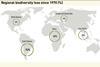
According to the United Nations Intergovernmental Panel on Climate Change, a 1.5°C average rise might threaten 20-30% of species. While this is significant, there has already been a 69% loss in global biodiversity since 1970, according to the recent Living Planet Report. The relationship between climate change and biodiversity loss creates a positive feedback loop, or in this case a vicious circle. Therefore, it is crucial to tackle both climate and biodiversity.
Because of the sheer number of humans – eight billion and counting – and the intensity with which we extract resources from the Earth, expand our consumption and generate waste, we have pushed many other species to the brink of extinction. In the coming decades, one million species are at risk of extinction, according to Intergovernmental Science-Policy Platform on Biodiversity and Ecosystem Services, and today the biomass of people on Earth exceeds that of wild animals by more than 10 times and combined humans and domesticated animals weigh more than 30 times that of all wild animals.
Biodiversity is important because it underpins the functioning of the delicate balance of ecosystems, which provide essential services that sustain all species including human wellbeing. Biodiversity loss is problematic in many ways and among the most immediate concerns is the weakening of its ability to provide important resources to people and nature through ecosystem services – clean water and air, food, regulation of the climate and the cycling of nutrients. Every species plays a crucial role in its ecosystem and the loss of even one species can have far-reaching consequences.
The richness of life on Earth is also important for enhancing human experience in too many ways to account for in this short article.
Yet despite the clear and indisputable value of biodiversity to the functioning of the planet and human existence, the health of the biosphere has been declining for hundreds of years and recently is in a precipitous fall. Human activities, such as deforestation, pollution, and overfishing, are causing often irreversible damage to ecosystems and driving species to extinction at an alarming rate.
Biodiversity loss and ecosystem collapse are cited as one of the fastest deteriorating risks for society in the short term. The World Economic Forum’s 2023 Global Risks Report identifies climate action and adaption failure, extreme weather and biodiversity loss and ecosystem collapse as among the five greatest threats to civilisation over the next decade.
Biodiversity loss can also lead to dire economic consequences. It is notoriously difficult to definitively establish the economic value of nature and equally challenging to calculate the economic consequences of its degradation. Today, markets do not reflect nature’s worth to society but several studies point to its critical importance. In the Economics of Biodiversity: The Dasgupta Review, the author notes that between 1992 and 2014, global produced capital per person doubled while the stock of natural capital declined by 40%.
Another report estimates that over half the world’s gross domestic product (GDP) is at risk from continued loss of nature, while solutions to enhance nature hold the potential to create trillions of dollars in annual business value and several hundred million new jobs globally. While the connection between risk and climate change has been a consideration of the financial markets for some time now, the economic risk of biodiversity loss is only now starting to emerge as a priority and will require more work to establish.
Examples of nature’s direct importance to our lives are many. Insects and animals assist in pollination which is essential for ecosystems and food chains as well as food production; plants and forests generate oxygen, regulate the climate and consume carbon dioxide and, along with soils, filter water; micro-organisms drive decomposition and are part of complex systems circulating nutrients like nitrogen and carbon. The biosphere drives biogeochemical cycles that are essential to all life on Earth.
In fact, we are so dependent on biological actions to provide critical resources that we have built a civilisation that assumes their continued success. For example, New York City supplies 90% of its water from a protected watershed in the Catskill Mountains, an area over 100 miles from the city. Rather than investing in an expensive water filtration system, the city invested in protecting land and forests and is now the beneficiary of the ecosystem services of naturally filtered water.
Cities are possibly the most complex of human inventions, and today dominate the world economy. While the built environment and cities generally are highly dependent on ecosystem services, these human-made conditions contribute to biodiversity loss in several important ways.
Within the urban space, biodiversity is significantly affected. It is not too strong to suggest that cities are generally an ecological disaster for regional biodiversity. When a city is initially founded, local species are mostly driven away by human activities. This is just the first phase in a city’s effects on biodiversity.
By 2050, 75% of the world’s population are expected to live in cities, which account for 80% of the global economy. As cities grow, the concentration of buildings and infrastructure alters the local climate, producing the urban heat island effect, changing the environmental conditions that microorganisms, insects, birds, reptiles, mammals and all types of plants depend on. Food and water sources for many of these species are inevitably affected. Spaces suitable as habitats are appropriated. The sounds of human activities and machines fill the air. Artificial light radiates from the central business district, confusing migrating birds.
One of the most significant threats to biodiversity is habitat loss. At the edge of a growing city, land is converted and the effect on biodiversity expands. Current projections of global urban expansion estimate that about 300,000sqkm of natural habitat will be converted to urban land between 2000 and 2030 and much of this expansion will occur near concentrated biodiversity.
Cities also have an enormous impact on global biodiversity. Through the extraction and production of goods and services for urban consumption, cities drive the degradation of natural capital in every region of the world.
Today, we know more about the effects of cities on biodiversity than at any other time in human history. We therefore have the opportunity and obligation to redirect certain decisions we make about the built environment to enhance biodiversity within and beyond the urban space. The benefits of this being direct to the quality of environments curated for both humans and all nature, on a local, regional and global scale, for our immediate wellbeing and more importantly our longer-term existence and survival.
Some important efforts are now beginning. For example, Colombia has launched a biodivercities programme that aims to catalyse significant actions to enhance urban biodiversity in 14 cities. Singapore established the City Biodiversity Index to guide it and other cities in monitoring and enhancing urban biodiversity.
Future articles in this series will explore the relationship of the built environment and biodiversity. We will show that much can be done to enhance the role of buildings and cities in reducing biodiversity loss globally and enhancing urban biodiversity locally. We will consider how we can understand the value of nature and how this can be integrated into our activities.
John E Fernández is director, MIT Environmental Solutions Initiative and professor, MIT Department of Architecture. Thomas Wiegelmann is managing director of Schroder Real Estate and honorary professor at UCL Bartlett School of Sustainable Construction