



Europe’s rearmament push creates structural tailwind for light industrial and logistics real estate markets, writes Britta Roden
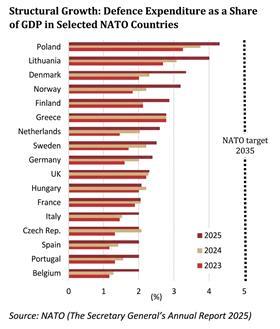
Europe’s security architecture is undergoing a profound transformation. Against the backdrop of the war in Ukraine, rising geopolitical tensions and a shifting US role within the European security framework, European governments are substantially increasing defence expenditure. At the same time, significant additional investment will be required to meet NATO’s 2035 target of allocating 3.5% of GDP to defence spending, complemented by a further 1.5% for broader defence and security-related activities.

In parallel, the European Union’s ReArm Europe initiative seeks to strengthen domestic defence capabilities by increasing the share of security-related value creation within Europe and reducing dependencies on non-European suppliers. This implies a sustained expansion of manufacturing capacity, supplier networks, research facilities, testing infrastructure and storage assets across the continent.
The resulting increase in demand for properties and rental space creates positive implications for the real estate industry. Although the expansion of armed forces will require additional real estate, these assets are generally publicly owned in most European countries, even though long-term public-private partnership (PPP) models have already been introduced in some cases or are being discussed as a means of accelerating the necessary infrastructure build-out.
Demand for space Is rising primarily in logistics and light industrial…
The European defence industry is experiencing a period of strong growth. According to ASD industry association, employment in the European aerospace, security and defence sector increased by 6.9% in 2024, reaching approximately 1.1m employees, driven mainly by defence-related activities. This growth is being generated not only by established defence contractors but by a rapidly expanding ecosystem of technology companies and defence-tech start-ups. The sector remains highly dynamic, driven by acquisitions, market consolidation and the entry of firms seeking new opportunities amid broader industrial restructuring in defence.
Real estate requirements vary across defence-sector segments. Traditional defence manufacturers remain centred on large-scale heavy industrial production facilities, often located outside major urban areas and predominantly owner-occupied. Given sufficient capital resources and land availability, these companies frequently expand through in-house development. In contrast, defence-tech firms and specialised technology divisions of larger defence groups, particularly software firms and start-ups, favour metropolitan innovation hubs with access to universities, research institutions, highly skilled labour and venture capital. Their requirements for offices, R&D facilities, laboratories and flexible production space are often met through leasing due to capacity constraints and the desire for flexibility during growth phases.
Light industrial and logistics assets appear best positioned to benefit from Europe’s defence transformation. The expansion of research, testing and production capacities is accompanied by increasing inventory requirements and a stronger focus on supply-chain resilience. Early evidence is already visible in occupational markets. According to Savills, defence manufacturers and their supply chains accounted for 8.5% of UK logistics and industrial take-up in 2025, representing roughly double the average share recorded over the previous decade.
Several studies estimate that Europe’s defence build-up could generate additional demand for between 2 and 5 million sqm of industrial and logistics space over the coming years, equivalent to approximately 8% to 20% of annual take-up volumes. However, much of this demand is expected to be absorbed through owner-occupation, site expansions and build-to-suit developments. As a result, only an estimated 20% to 30% of the total demand potential is likely to become accessible to the institutional leasing market.
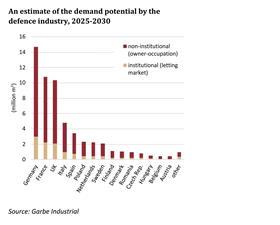
The strongest stimulus for rental markets is therefore likely to originate from defence-tech occupiers and the technology divisions of large defence companies. Traditional heavy-industry defence manufacturers, by contrast, may increasingly utilise existing industrial sites or repurpose facilities released by branches currently undergoing structural adjustment, such as former automotive production plants.
…But subject to specific constraints…
The real estate requirements of defence-related occupiers differ from those of conventional industrial and logistics users. Beyond access to established industrial and technology clusters, security considerations play a central role. Requirements frequently include controlled site access, perimeter security, surveillance infrastructure, segregation of sensitive operational areas and resilient energy supply systems. While many of these features are relevant for other occupiers, they are often essential for defence-sector users.
As a result, not every industrial or logistics property is immediately suitable for defence-related activities. Existing and rapidly deployable “defence-ready” facilities therefore enjoy a competitive advantage. More broadly, occupiers within the defence sector often place a higher priority on the immediate availability of suitable space than on traditional real estate considerations such as rental levels.
…And focused on regional clusters
Despite its current growth trajectory, the defence sector remains relatively concentrated in terms of companies, employment and geographic footprint. Consequently, demand for real estate is likely to remain focused on a limited number of established regional clusters. This applies both to traditional defence manufacturers, which benefit from specialised labour pools and supplier networks, and particularly to defence-tech companies. Attractive locations typically emerge around a country’s leading technology, innovation and start-up ecosystems, as illustrated by clusters ranging from Helsinki and Stockholm to Greater London, Île-de-France, Madrid and Rome.
Within Germany, the Greater Munich area holds the leading position as defence-tech cluster. Building on a long-established aerospace and defence ecosystem anchored by companies such as Airbus, Hensoldt and KNDS, the region has also produced several of Europe’s most successful defence-tech start-ups in recent years, including Helsing, Quantum Systems and Isar Aerospace.
Traditional defence activities also remain concentrated in established locations, notably the Lake Constance region and the northern coastal corridor encompassing Kiel, Hamburg and Bremen. Other regional hotspots are closely linked to major manufacturers, including Kassel, where KNDS and Rheinmetall operate large production facilities.
A Meaningful, yet not dominant, demand driver
Europe’s defence transformation is creating additional demand for light industrial and logistics real estate. The political commitment to strengthening Europe’s defence capabilities and reducing strategic dependencies in defence production provides a supportive long-term backdrop for these sectors. Nevertheless, the magnitude of the impact should not be overstated. Additional space requirements are likely to moderate once the current capacity build-up phase matures and sufficient production infrastructure has been established.
At the same time, increasing competition within the defence industry may limit further expansion. Furthermore, a substantial share of demand will be satisfied through owner-occupation, facility expansions and specialised build-to-suit solutions, reducing the volume accessible to the institutional investment market. Even so, defence has clearly emerged as a relevant structural demand driver for Europe’s light industrial and logistics property sectors and is likely to remain so for the foreseeable future.
To read the latest IPE Real Assets magazine click here.