



The Hamburg Declaration is as much about geopolitics as it is energy transition – and is highly ambitious. Christopher Walker reports on the groundbreaking offshore wind energy-security pact
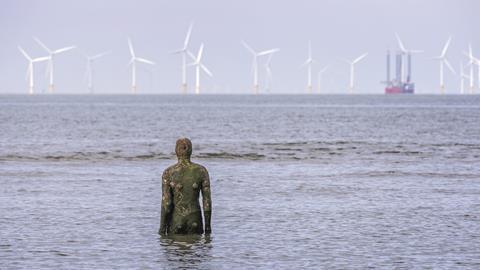
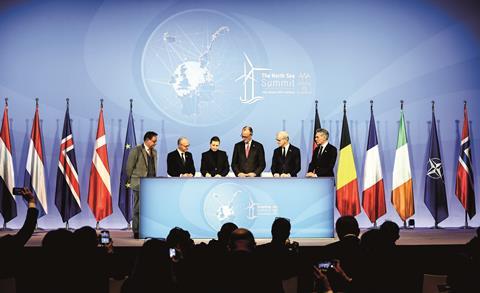
The Hamburg Declaration, an energy security pact signed by 10 European countries in January, pledges to accelerate large-scale offshore wind deployment and related grids. It reaffirms the goal of the earlier Ostend Declaration of achieving 300GW of offshore wind in Europe by 2050 while adding a further joint target of some 100GW of cross-border offshore projects in the North Sea.
As part of the declaration, Belgium, Denmark, Germany, the Netherlands and the UK will develop an interconnected offshore grid through shared planning and cost-sharing frameworks. Governments in these countries are committed to coordinated planning and harmonised regulation, as well as to de-risking frameworks, including an offshore financing framework and more predictable auction pipelines. The declaration also stresses integrated offshore wind hydrogen projects and grid interconnectors.
“The Hamburg Declaration is hugely welcome,” says Richard Threlfall, the former global head of infrastructure at KPMG who today is an independent consultant and describes himself as an advocate for a sustainable future. “It recognises the reality that renewables are the energy of the future. They solve the energy trilemma, providing not just energy sustainability, but also energy security and, in the long run, the cheapest form of energy. This is increasingly urgent as electricity dominates new energy demand.”
As such, it is a declaration of faith in the energy transition crusade by European leaders, and adds proof, if it were needed, of the ever-widening Atlantic divide on this issue.
A failure of offshore wind power in the US predates President Donald Trump (the US Department of Energy’s 2023 Offshore Wind Market Report showed just two operating projects in US waters in 2023, generating a mere 42MW, combined), but the US president has turned reluctance to outright hostility, ordering a pause to new federal offshore wind leasing in 2025. The US has only a few hundred megawatts of offshore wind operating today and around 1GW in sight if the first big projects finish commissioning.
Europe presents a starkly contrasting picture. The latest consolidated figure from WindEurope indicates that the continent has about 37GW of installed offshore wind capacity. In the first half of 2025, Europe added about 0.74GW of new offshore capacity as part of 6.8GW of total wind installations, supported by a rebound in turbine orders and roughly €34bn in new investment commitments.
Hamburg’s 100GW target widens this transatlantic gap in ambitions even further, but it must also be seen in the context of the increasing importance of energy security and resilience.
Geopolitics and energy security to the fore
The declaration is welcome because it “responds to the need for energy-supply resilience”, says Threlfall. “Pooling capabilities offers efficiency in new capacity development, and building interconnectors helps individual countries to meet peaks in demand.” But it is also symobolic. “It sends a signal around the world that the countries involved continue to believe in international collaboration rather than confrontation,” says Threlfall. “Perhaps that is the most important thing at this moment in time when it can seem that the international order is under threat. Sharing infrastructure is a strong vote for a shared future.”
Others talk about ‘signals’ the declaration sends. “The Hamburg Declaration marks an important step away from nationally fragmented offshore policy towards a coordinated European development logic in the North Sea region,” says Stefan Klett, CEO of Veja Mate Offshore Project, which is backed by Commerz Real. “Its greatest added value lies not so much in new target figures as in the political commitment to jointly plan and finance offshore wind, grid infrastructure and cross-border projects in the future. The targeted expansion path of around 15GW per year from 2031 onwards sends a clear signal to investors and supply chains.” That message, he adds, concerns the replacing of the volatility of liquefied natural gas (LNG) imports with “stability and predictability”.
Following the Russian invasion of Ukraine, the EU scrambled to replace its massive Russian pipeline gas imports, turning to LNG imports. By 2023, EU countries were importing around 134bn cubic metres of LNG, representing about 42% of total EU gas imports, more than doubling the share in 2021. According to Eurostat, by the third quarter of 2025, the US supplied about 60% of the EU’s LNG imports, far ahead of other exporters. To a great extent, therefore, the EU has swapped its dependence on Russian pipeline gas with one that hinges on American LNG.
Is the Hamburg initiative really necessary when Europe has so much access to US LNG? “Absolutely necessary,” says Threlfall, “because of the decarbonisation imperative to invest in renewables, and the geopolitical risk of relying on US imports.”

“Europe’s goal should be independence from all external suppliers, including the US, not simply switching dependency from one region to another”
Andreas Ochsenkühn
Tensions between the US and Europe over the future of Greenland have highlighted the potential leverage that the former currently has over the latter’s energy security.
Andreas Ochsenkühn, head of portfolio management for sustainable infrastructure at KGAL, agrees with Threlfall’s view, saying: “Strategic autonomy is the point. LNG is a globally-traded commodity. Europe’s goal should be independence from all external suppliers, including the US, not simply switching dependency from one region to another. Offshore wind is a domestic resource that reduces long-term import exposure and improves resilience.”
Are the ambitions realistic?
While the geopolitical rationale of the declaration is clear, are its targets feasible? “The ambitions are not really new, but they remain ambitious,” suggests Klett. “Overall, provided that the political commitments are now consistently implemented in regulation, auctions and infrastructure, the Hamburg Declaration strengthens the investment basis for offshore wind in the North Sea.”

“The Hamburg Declaration strengthens the investment basis for offshore wind in the North Sea”
Stefan Klett
Nevertheless, Jonathan Bruegel, power analyst for Europe at the Institute for Energy Economics and Financial Analysis (IEEFA), says: “In the short term, the Hamburg Declaration is unlikely to materially change capital allocations on its own. Investors and developers ultimately respond to concrete project pipelines, permitting outcomes, revenue frameworks and risk allocation. For now, the declaration should be seen as a signalling and coordination tool rather than a trigger for immediate reallocation.”
Threlfall agrees: “The ambitions are realistic in principle, but the challenge will be actual implementation and pace – especially given there is no supranational obligation being created, and national planning laws will continue to apply, leaving plenty of scope for good intent to fail in the reality.”
Whether the declaration ultimately influences investment flows will depend on how quickly and consistently its provisions are implemented at national and regional levels. For example, France is the biggest laggard in terms of offshore wind installed capacity, despite having the second highest potential in Europe – as highlighted by IEEFA. “The Hamburg Declaration may lead France to accelerate offshore wind deployment in the Atlantic,” says Bruegel.
Ochsenkühn believes success is possible, “but only if governments speed up on permitting, grid build-out and improved auction design which turned out to be a major obstacle over the past few years”. He adds: “Investors will judge realism by whether timelines compress significantly and project mortality risk drops. Headline gigawatt numbers are not so important for project developers and investors; for those parties, the final outcome is more relevant.”
Permitting and grid constraints
Maintaining a build-out rate of around 15GW per year is certainly constrained by permitting and grid connection risk in Bruegel’s view. “Offshore projects are increasingly granted faster than transmission infrastructure can be delivered,” he says. In Germany, delays to offshore grid links, such as Borwin and DolWin 5 and 6, have pushed back commissioning timelines, while in the Netherlands, TenneT has acknowledged multi-year delays to several 2GW offshore grid connections due to supply-chain and onshore-permitting constraints. “Grid risk is now a central investment concern,” says Bruegel. “Developers face uncertainty over connection dates, curtailment exposure and compensation mechanisms, particularly where transmission system operators (TSOs) and project timelines are misaligned.”
Threlfall cites bottlenecks such as “supply-chain capacity, inflation and views on return expectations” but he also offers an element of hope. “The deal doesn’t really resolve any of these directly, but points towards a co-operation which may over time help de-risk.” A proposal for an offshore financing framework, expected to be backed by the European Investment Bank, is the most important provision, he says. “Whilst the detail of what is envisaged is missing, this feels like the most concrete of the actions set out in the declaration.”
One of the biggest bottlenecks concerns monopile installation (MPI) vessels – specialist ships used for installing offshore wind farms. “Based on the studies we have done on utilisation per year and weather-related downtime, there is not sufficient capacity,” Threlfall says.
Does hydrogen have a role?
There are also doubts about integrating hydrogen into the mix, and to be financially viable from an investment perspective. “Hydrogen makes sense politically as the storage medium in the medium to long term, but for me is too far in the future to impact return expectations now,” says Threlfall.
Ludovico Cappelli, portfolio manager at Van Lanschot Kempen, agrees. He says: “The technology sounds great theoretically, but the math still needs to add up to substantial returns to be viable – and we are far from that today. Green hydrogen may well be the future but, for now, it fails the investor math.”

“In a world which is eventually 100% renewable, Europe’s competitive advantage is more in wind”
Richard Threlfall
Notwithstanding these problems, there is a remarkable consensus on how big a part offshore wind will play in the future of European energy – at least among politicians and sustainability enthusiasts. Its role will be “fundamental” for Europe, says Threlfall, “because in a world which is eventually 100% renewable, the countries with sun will be mostly about solar – as we are already seeing – and Europe’s competitive advantage is more in wind”.
What about the headline goal of 300GW by 2050? Bruegel declines to comment directly on the target, but says: “Based on current grid outlooks from TSOs such as TenneT, 50Hertz, Energinet and National Grid, IEEFA would assume the capacity to be about 120 to 140GW of offshore wind connected by around 2035.” In IEEFA’s view, at that scale, North Sea offshore wind could supply around 15% of EU, UK and Norway electricity, with grid execution – particularly onshore reinforcement and [high-voltage direct current] delivery – remaining the main constraint.”
Cappelli warns: “What’s missing is price visibility, and thus real investment signals. Targets don’t build wind farms – returns do.”
For Europe, wind power “will remain a central pillar”, insists Ochsenkühn. “However, its value increasingly depends on the surrounding system, like grids, storage, interconnectors, rather than generation capacity alone,” he says. For investors, the opportunity set “is expanding from wind farms to wider infrastructure portfolios that support independence and resilience”.